
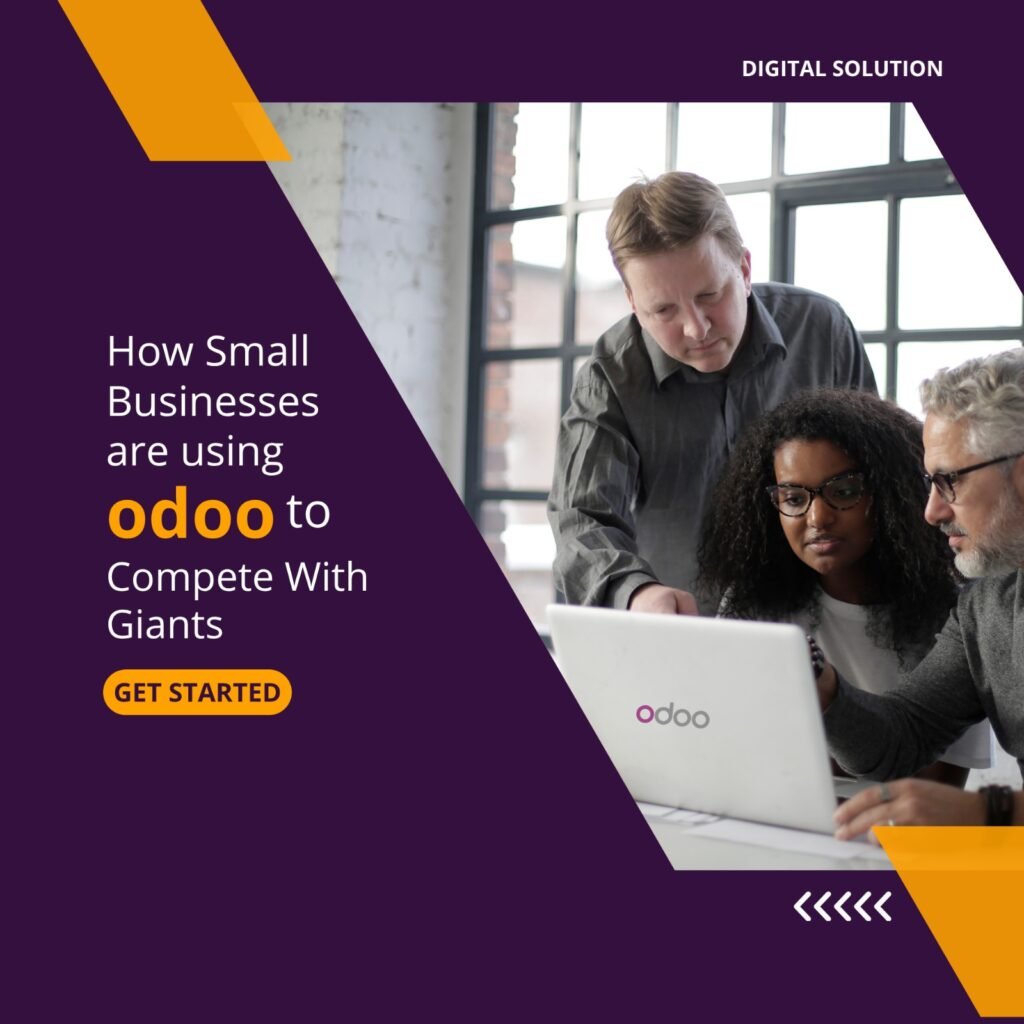


Odoo for small business owners is no longer just an option. In the traditional business landscape, the “Goliath” corporations held a seemingly insurmountable advantage. They possessed the capital to invest in massive IT infrastructures, the resources to hire legions of data analysts, and the scale to optimize every inch of their supply chain. Small and medium-sized enterprises (SMEs), the “Davids” of the world, were often left struggling with fragmented tools, manual spreadsheets, and a lack of real-time visibility into their own operations.
However, the digital revolution has shifted the battlefield. Today, the competitive edge is no longer defined by the size of a company’s server room, but by the agility of its data and the integration of its processes. At the heart of this transformation is Odoo, an all-in-one Open Source ERP (Enterprise Resource Planning) solution that is effectively leveling the playing field.
By leveraging professional Odoo solutions, small businesses are now able to replicate—and often exceed—the operational efficiencies of global giants.
The Traditional “Giant” Advantage and Why it’s Eroding
For decades, large corporations dominated through “economies of scale.” They used expensive, proprietary systems like SAP or Oracle, costing millions in licensing and implementation. These systems allowed them to:
Centralize Data: Every department talked to the next.
Automate Workflows: Reducing human error and speeding up delivery.
Predict Trends: Using historical data to forecast demand.
Small businesses, conversely, operated in silos. The sales team used one software, the warehouse used another, and the accounting team was stuck manually reconciling the two. This “data fragmentation” led to slow decision-making and missed opportunities.
The erosion of this advantage began with the rise of modular, cloud-based ERPs. Small businesses no longer need a multi-million dollar budget to access world-class technology. They need a system that grows with them.
What Makes Odoo the Ultimate Equalizer?
Odoo’s disruptive power lies in its unique architecture. Unlike legacy ERPs that are rigid and “top-heavy,” Odoo is built on a modular framework. This means a small business can start with a single module—perhaps just CRM or Invoicing—and add functionality as they scale.
1. Integration Without the “Enterprise” Price Tag
The biggest drain on a small business is “app fatigue.” Using Slack for communication, Trello for tasks, Mailchimp for marketing, and QuickBooks for accounting creates a “spaghetti” of integrations that often break. Odoo replaces this mess with a single, unified database. When a sales order is confirmed in the Odoo Sales module, the Inventory is automatically updated, a draft invoice is created in Accounting, and the Manufacturing team receives a work order—all in one click.
2. Open Source Flexibility
Giant corporations often find themselves “vendor-locked.” They are at the mercy of their software provider’s roadmap. Because Odoo is open-source, businesses working with expert consultants at EUSOL can customize the software to fit their specific niche rather than changing their business processes to fit the software.
3. Real-Time Data for Agility
Small businesses are naturally more agile than giants. They can pivot faster—provided they have the data. Odoo provides real-time dashboards that show exactly where the business stands. Whether it’s cash flow, stock levels, or lead conversion rates, SMEs can make “giant-level” strategic decisions in minutes, not weeks.
Strategic Modules for Competitive Edge
To compete with industry leaders, small businesses focus on three core areas: Customer Experience, Operational Efficiency, and Financial Health. Odoo provides specific “Power Modules” for each.
Unified CRM and Sales Automation
In a world where customer service is the new marketing, giants use complex CRM systems to track every interaction. Odoo CRM brings this same capability to the SME.
Lead Scoring: Automatically rank leads based on their probability of closing.
Pipeline Management: Drag-and-drop interfaces to track deals through various stages.
Automated Follow-ups: Ensure no lead falls through the cracks, a common pitfall for small teams.
Intelligent Inventory and Supply Chain Management
Inventory is often the largest expense for a small business. Giants use “Just-In-Time” (JIT) manufacturing to keep costs low. Odoo Inventory allows small businesses to do the same through:
Automated Reordering Rules: The system automatically creates Purchase Orders when stock hits a certain level.
Multi-Warehouse Management: Track stock across various locations, including retail stores and online warehouses.
Traceability: Full serial number and lot tracking, essential for competing in industries like food, beverage, or electronics.
Financial Transparency with Odoo Accounting
Many small businesses fail not because of a lack of sales, but because of a lack of cash flow visibility. Odoo Accounting automates the “boring” parts of finance:
Bank Synchronization: Automatically pull transactions from your bank.
AI-Powered Invoicing: Scan a PDF bill, and Odoo uses OCR to fill in the details.
Global Compliance: Odoo is localized for over 120 countries, allowing small businesses to expand internationally with ease.
Cost-Efficiency: Odoo vs. Enterprise Legacy Systems
According to reports from Gartner, the Total Cost of Ownership (TCO) for traditional ERPs can be 5x to 10x higher than modern open-source alternatives.
| Feature | Legacy ERP (SAP/Oracle) | Odoo |
| Implementation Time | 12 – 24 Months | 2 – 6 Months |
| User Interface | Complex / Dated | Modern / Intuitive |
| Customization | Extremely Expensive | High / Accessible |
| Cost | High Licensing + Maintenance | Affordable / Modular |
For an SME, this cost difference isn’t just a saving; it’s capital that can be reinvested into product development, marketing, or hiring. By partnering with an Odoo implementation specialist, businesses ensure they aren’t paying for features they don’t use, further driving down the TCO.
Scalability: The “Start Small, Grow Big” Philosophy
The “Giants” of tomorrow are the small businesses of today that refuse to be limited by their tools. Odoo supports this journey through its “Apps Store” ecosystem, which features over 40,000 community-developed modules.
Whether a business is expanding into E-commerce, launching a subscription model, or opening a physical retail branch using Odoo POS (Point of Sale), the infrastructure is already there. There is no need to “migrate” to a bigger system when you hit $10M in revenue. You simply turn on more Odoo features.
Overcoming the Implementation Hurdle
While Odoo provides the tools, the “magic” happens during implementation. Many small businesses attempt to “DIY” their ERP setup, only to realize that an ERP is not just software—it’s a digital blueprint of their business.
This is where EUSOL provides the bridge. As specialists in digital transformation, the focus is on:
Business Analysis: Understanding the unique “pain points” of the small business.
Configuration: Setting up Odoo to automate those specific manual tasks.
Training: Ensuring the team is empowered to use the data Odoo provides.
Effective implementation ensures that the “David” in this scenario isn’t just holding a sling, but a precision-guided tool designed to hit the mark every time.
Conclusion: The New Business Reality
The barrier to entry for high-level business technology has collapsed. Small businesses are no longer at a disadvantage because of their size. In fact, their size, combined with the power of Odoo, makes them more dangerous competitors than ever. They are faster, more personalized, and now, just as data-driven as the giants.
If you are ready to stop managing your business through spreadsheets and start competing at an enterprise level, it is time to explore the world of Odoo.
Ready to transform your operations? Visit eusol.net to discover how our Odoo consulting and implementation services can help your business outpace the competition.