
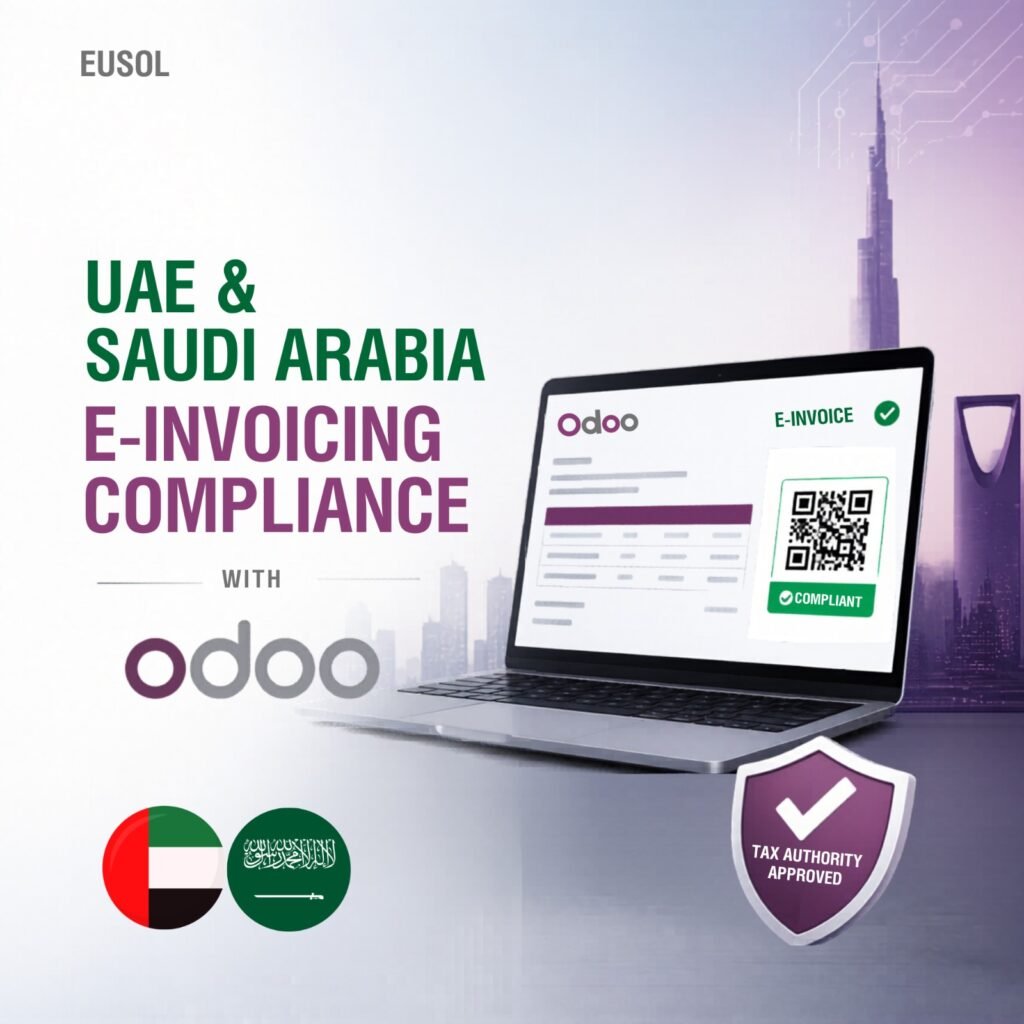


The clock is ticking for businesses across the Gulf. The UAE and Saudi Arabia — two of the region’s most powerful economies — have both rolled out mandatory e-invoicing regulations that are fundamentally changing how businesses issue, submit, and store invoices. If your company operates in either country and you’re still relying on PDF invoices, email attachments, or manual billing processes, you are at serious risk of non-compliance, heavy fines, and operational disruption.
The good news? Odoo ERP is already built for this. With native support for both the UAE’s PINT AE framework and Saudi Arabia’s ZATCA Fatoora platform, Odoo gives Gulf businesses a powerful, all-in-one solution to meet every regulatory requirement — without replacing your existing workflows.
This guide covers everything you need to know: the deadlines, the technical requirements, the compliance steps, and exactly how Odoo makes it all manageable.
Why E-Invoicing Compliance Is Now Non-Negotiable in the Gulf
The move toward mandatory e-invoicing across the GCC is not a trend — it is a government-driven transformation of how tax and commerce work. Both the UAE Federal Tax Authority (FTA) and Saudi Arabia’s Zakat, Tax and Customs Authority (ZATCA) are pushing for 100% digital invoice transparency. The goals are clear: reduce tax evasion, improve VAT compliance, and create a real-time financial audit trail for every business transaction.
For companies operating in the UAE and Saudi Arabia, this is one of the most significant compliance changes in recent memory. Businesses that fail to adapt will face financial penalties, reputational risk, and potential suspension of their VAT registration. Those that get ahead of the deadline will gain competitive advantages: faster payments, cleaner audits, and more efficient operations.
Odoo, already the most widely adopted ERP platform in the Middle East, is at the center of this transformation. With a growing network of certified partners across the GCC and built-in localization modules for both countries, Odoo is the go-to solution for businesses that need to comply without disrupting day-to-day operations.
Understanding the UAE E-Invoicing Mandate (PINT AE Framework)
The UAE’s e-invoicing mandate was formalized through Ministerial Decisions 243 and 244 of 2025, establishing a national framework that requires businesses to issue, exchange, validate, and archive invoices in a structured digital format. This is not simple PDF digitization — it is a complete shift to machine-readable XML invoices transmitted through government-approved channels.
Key Deadlines Every UAE Business Must Know
The UAE mandate rolls out in phases based on business size:
- July 1, 2026 — Pilot program launches. Voluntary adoption opens for all businesses.
- July 31, 2026 — Large businesses with annual revenue of AED 50 million or more must appoint an Accredited Service Provider (ASP).
- January 1, 2027 — Mandatory e-invoicing goes live for large businesses (AED 50M+ annual revenue).
- March 31, 2027 — SMEs must appoint their ASP by this date.
- July 1, 2027 — Full mandatory compliance for all businesses, including SMEs.
The penalty for missing these deadlines is AED 5,000 per month. All invoices must be issued within 14 days of the taxable transaction, and B2C transactions are currently excluded from the mandate.
What Is PINT AE?
PINT AE — which stands for Peppol International Invoice, Arabic Emirates — is the UAE’s official adaptation of the global Peppol e-invoicing standard. It defines the exact data fields, formats, and sequences that every compliant e-invoice must follow. Fields that are optional in other Peppol jurisdictions may be mandatory under PINT AE, including specific VAT treatment codes, Tax Registration Numbers (TRNs), and supply classification identifiers.
Every invoice must be structured as XML, validated against the PINT AE schema, and transmitted through a ministry-accredited ASP connected to the Peppol network. Any mismatch in field mapping will result in rejection. This makes ERP configuration — not just software selection — the critical success factor.
How Odoo Handles PINT AE Compliance
Odoo’s UAE localization module is designed specifically for PINT AE output. Here is what the configuration process looks like:
Step 1 — Enable the UAE Localization Module. Activate the UAE localization and e-invoicing module within your Odoo instance to unlock the correct tax configurations, currency fields, and invoice templates.
Step 2 — Map PINT AE Fields. Configure your Odoo customer master data to include buyer TRN numbers, HS codes, supply classification identifiers, and currency fields. Any missing or incorrect data will cause invoice rejection at the ASP level.
Step 3 — Connect to an FTA-Accredited ASP. Odoo itself is your ERP — you need to integrate it with an FTA-accredited ASP to validate and submit invoices to the FTA in real time. Odoo’s modular structure makes this ASP integration more flexible than most other ERP platforms.
Step 4 — Test on the Pilot Environment. Use the July 2026 voluntary pilot window to test your Odoo configuration end-to-end before mandatory go-live. Data cleanup, ASP onboarding, and testing typically require 6 to 16 weeks depending on your current data quality.
Step 5 — Go Live. Once fully validated, compliance runs automatically in the background. Odoo handles invoice generation, XML conversion, digital signing, and ASP transmission — all within a single unified workflow.
Understanding Saudi Arabia’s ZATCA Phase 2 (Fatoora Integration)
Saudi Arabia launched its e-invoicing initiative earlier than the UAE and is already deep into full implementation. The ZATCA e-invoicing program — known as Fatoora — operates in two phases, with Phase 2 being the critical integration phase that connects businesses directly to ZATCA’s platform in real time.
ZATCA Phase 1 vs. Phase 2: What’s the Difference?
Phase 1, enforced since December 4, 2021, required businesses to generate and store invoices electronically using ZATCA-compliant software. Phase 2 goes much further — it is the Integration Phase, requiring businesses to connect their invoicing systems directly to ZATCA’s Fatoora portal and transmit invoices electronically in real time or near-real time.
Phase 2 is being rolled out in waves based on annual taxable revenue. The revenue threshold started at SAR 3 billion for the first wave in January 2023 and has progressively decreased. By the 23rd wave (covering businesses with taxable turnover exceeding SAR 750,000), the deadline was March 31, 2026. Wave after wave, ZATCA is reaching deeper into the SME market, and eventually all VAT-registered businesses in Saudi Arabia will be required to comply.
What ZATCA Phase 2 Requires Technically
Phase 2 compliance is technically demanding. Every invoice must include:
- Real-Time Reporting (CTR): Invoices must be transmitted to ZATCA’s Fatoora system immediately upon issuance — or within 24 hours for simplified invoices.
- Cryptographic Digital Signature (UUID): Each invoice must carry a universally unique identifier and a ZATCA-approved digital signature to guarantee authenticity and prevent tampering.
- QR Code Generation: Every simplified tax invoice (B2C) must include a scannable QR code containing encoded invoice data.
- XML or PDF/A-3 Format: Invoices must be issued in structured XML or PDF with embedded XML, transmitted via direct API integration with Fatoora.
- Archiving: Businesses must retain all invoices for five years in a secure, accessible format.
Penalties for non-compliance range from SAR 5,000 for failing to issue or store invoices electronically, to SAR 10,000 for deleting or altering an e-invoice, to SAR 50,000 for serious repeat violations.
How Odoo Integrates with ZATCA Fatoora
Odoo provides dedicated modules for full ZATCA Phase 2 compliance, available from Odoo version 15 and all future versions including Odoo 17 and 18.
The key modules to install are:
- l10n_sa — Saudi Arabia Accounting localization
- l10n_sa_edi — Saudi Arabia E-Invoicing (standard tax invoices)
- l10n_sa_edi_pos — Saudi Arabia E-Invoicing for Point of Sale (simplified invoices)
The Odoo ZATCA integration workflow works as follows:
- Onboard Journals on the Fatoora Portal. Every sales journal in Odoo requires a separate device onboarding on the Fatoora simulation portal. Each journal generates its own OTP from the portal.
- Test on the Simulation Portal. Before going live, run your full invoicing workflow on ZATCA’s Simulation Fatoora environment. Generate realistic invoices and confirm end-to-end validation. Never skip this step — test invoices accidentally sent to the production portal can trigger liability.
- Switch to Production. Once your simulation testing is complete, set the API Mode to Production in Odoo settings. This is a one-way switch — you cannot revert to simulation after going live.
- Automated Real-Time Submission. After go-live, every confirmed invoice in Odoo is automatically submitted to Fatoora. If you choose not to process immediately, Odoo batches and sends all unsubmitted invoices at end of day.
Key features of Odoo’s ZATCA integration include automated VAT compliance, digital signature and QR code generation, secure API connectivity with ZATCA, real-time invoice validation, and audit-ready compliance reports.
Odoo vs. Other ERP Systems for Gulf E-Invoicing Compliance
When it comes to UAE and Saudi Arabia e-invoicing compliance, not all ERP systems are equally prepared. Here is how Odoo compares:
| Feature | Odoo | Legacy ERP Systems |
|---|---|---|
| Native PINT AE (UAE) module | ✅ Yes | ❌ Requires custom build |
| Native ZATCA Phase 2 module | ✅ Yes | ⚠️ Varies by vendor |
| Arabic/bilingual invoice support | ✅ Built-in | ⚠️ Often requires add-on |
| Open-source & customizable | ✅ Yes | ❌ Closed-source |
| Integrated ERP (Sales + Finance + Inventory) | ✅ One system | ❌ Siloed modules |
| GCC localization | ✅ UAE, KSA, Bahrain | ⚠️ Limited coverage |
| Cost for SMEs | ✅ Affordable | ❌ High licensing fees |
Odoo’s biggest advantage is that it handles purchasing, sales, inventory, HR, and e-invoicing in a single unified system. Gulf businesses using Odoo can manage their complete compliance workflow without switching between platforms or maintaining multiple vendor relationships.
Common Mistakes Gulf Businesses Make With E-Invoicing Compliance
Understanding the mandate is not enough — execution matters. Here are the most common compliance failures to avoid:
Leaving master data cleanup too late. PINT AE and ZATCA both require precise data fields: TRNs, buyer tax IDs, HS codes, and supply classifications. Businesses that discover missing data after the deadline has passed face immediate rejection of all invoices.
Underestimating the implementation timeline. Data cleanup, ASP onboarding, module configuration, and end-to-end testing typically require 6 to 16 weeks. Waiting until 30 days before the deadline is a recipe for failure.
Confusing PDF invoices with e-invoices. A PDF invoice emailed to a buyer is not a compliant e-invoice. Compliance requires structured XML generated and transmitted through an ASP — the format is machine-readable, not human-readable in the traditional sense.
Skipping the simulation environment for ZATCA. Businesses that go live on ZATCA’s production environment without completing simulation testing risk submitting test transactions as real invoices, which can trigger penalties.
Not appointing an ASP on time. In the UAE, large businesses must appoint an ASP by July 31, 2026. Missing this deadline alone results in AED 5,000/month in fines — even before the main mandate kicks in.
Why Now Is the Best Time to Upgrade to Odoo for GCC Compliance
The July 2026 voluntary pilot window in the UAE is a rare gift: an opportunity for businesses to test their systems, identify data gaps, and fix configuration issues without regulatory risk. Companies that start now — rather than waiting for the January 2027 mandatory deadline — will have the most time to ensure a smooth, penalty-free transition.
For Saudi Arabia, the ZATCA wave system means that if your business hasn’t already received notification, it is coming. Wave 23 already captures businesses with taxable revenues above SAR 750,000. Future waves will expand this to virtually every registered business in the Kingdom.
Odoo’s presence in the GCC is substantial. Saudi Arabia ranks among the top countries globally by number of Odoo partners, with a dense network of certified implementers who specialize in both ZATCA and PINT AE compliance. Whether you are a large enterprise in Riyadh or an SME in Dubai, there is a certified Odoo partner equipped to get you compliant quickly.
Action Plan: How to Get Your Odoo System Ready for Gulf E-Invoicing
If you are using Odoo and need to prepare for UAE or Saudi Arabia compliance, here is your step-by-step action plan:
Week 1–2: Assessment. Audit your current Odoo version and installed modules. Identify gaps in customer master data (TRNs, tax IDs, HS codes). Confirm your annual revenue to determine which compliance wave or phase applies to you.
Week 3–4: Partner & ASP Selection. Engage a certified Odoo partner with GCC e-invoicing experience. For UAE compliance, identify and begin onboarding with an FTA-accredited ASP. For KSA, ensure your Odoo modules include l10n_sa and l10n_sa_edi.
Week 5–10: Configuration & Testing. Install and configure the relevant localization modules. Map all required fields to the PINT AE or ZATCA schema. Run end-to-end tests in the simulation environment. Resolve any XML validation failures.
Week 11–12: Team Training & Go-Live. Train your finance and accounts team on the new workflow. Go live on the production environment. Confirm that invoices are being submitted, validated, and archived correctly.
Conclusion: Compliance Is a Competitive Advantage
E-invoicing compliance in the UAE and Saudi Arabia is not just about avoiding fines — it is about positioning your business as a trusted, digitally mature operator in one of the world’s fastest-growing regions. Companies that achieve compliance early will benefit from faster invoice processing, cleaner financial audits, stronger supplier and client relationships, and a more streamlined back office.
Odoo ERP, with its native UAE and KSA localization modules, Arabic bilingual support, and flexible ASP integration architecture, is the most practical and cost-effective path to full compliance for Gulf businesses of every size.
Do not wait for a ZATCA notification or an FTA penalty notice to start your compliance journey. The pilot phase is open. The tools are ready. The only question is whether your business will be ahead of the deadline — or scrambling to catch up.
Ready to make your Odoo system fully compliant with UAE and Saudi Arabia e-invoicing regulations? Contact a certified Odoo partner in the GCC today and start your compliance journey before the deadlines arrive.