



Odoo ERP for construction companies is rapidly becoming the go-to solution for contractors and builders across the Gulf region and beyond — and for good reason. Managing a construction business means juggling multiple projects, dozens of subcontractors, fluctuating material costs, and a workforce spread across different sites. Most companies still try to handle this with spreadsheets, disconnected tools, and endless email chains. The result is cost overruns, missed deadlines, and razor-thin margins that disappear before a project even closes.
This guide covers everything you need to know about how Odoo ERP solves the most critical challenges in construction — from project tracking and procurement to payroll and financial reporting — all from one centralized platform.
Why Construction Companies Need an ERP System
The construction industry operates differently from most other sectors. Projects are long, complex, and dynamic. A single contract can involve hundreds of material line items, multiple subcontractors with different payment terms, laborers across multiple sites, and clients expecting regular progress updates.
Without a unified system, this creates serious operational blind spots:
- Project managers have no real-time view of actual vs. budgeted costs
- Procurement teams place duplicate orders or miss critical material deliveries
- Finance teams struggle to reconcile invoices against progress milestones
- HR departments manually calculate wages, overtime, and site allowances
- Subcontractor payments get delayed, creating disputes and project slowdowns
Research consistently shows that poor planning and resource management cause around 30% of construction projects to fail. An ERP system directly addresses these failure points by connecting every department and every site into one live data environment.
What Is Odoo ERP and Why It Fits Construction
Odoo is an open-source, modular ERP platform used by over 16 million users globally across industries. Unlike construction-specific tools that lock you into rigid workflows, Odoo lets you build a system tailored to how your business actually runs — starting with the modules you need and expanding over time.
For construction, Odoo covers the full project lifecycle: from the first client inquiry and quotation, through on-site execution, material management, and subcontractor coordination, all the way to final invoicing and financial reporting. Every module feeds into a single database, which means the purchase order your procurement team raises is immediately visible to your finance team and linked to the correct project budget.
This is the core advantage of Odoo ERP for construction companies: no more data silos, no more manual reconciliation, and no more discovering a budget overrun after it’s too late to act.
Key Modules of Odoo ERP for Construction Companies
1. Project Management
Odoo’s project module gives construction firms a centralized dashboard for managing tasks, milestones, and deadlines across every active site. You can organize work using Kanban boards or Gantt charts, assign tasks to specific team members, and track completion rates in real time.
Project managers can link purchase orders, timesheets, and inventory directly to a project, giving an always-current view of what has been spent versus what was planned. When a delay on one task affects downstream activities, the system reflects that immediately — allowing proactive adjustments rather than reactive firefighting.
For companies managing multiple concurrent projects, Odoo provides a consolidated view across all of them, making it easier to reallocate resources, prioritize critical paths, and protect profit margins on each contract.
2. Job Costing and Budget Control
Budget overruns are the single biggest threat to construction profitability. Odoo integrates financial data directly with project operations, so every cost — materials, labor, equipment, subcontractors — is allocated to the right project and the right budget line in real time.
You can set up a Bill of Quantities (BOQ) within Odoo and track actual expenditure against planned quantities as the project progresses. This gives project managers and finance teams live visibility into cost performance, allowing them to catch overruns early rather than discovering them at month-end when recovery is no longer possible.
Odoo also supports milestone-based invoicing, which is essential for construction cash flow. You can invoice clients progressively as work is completed and certified, linking site progress reports directly to Interim Payment Certificates (IPC) to reduce disputes and speed up payment cycles.
3. Procurement and Inventory Management
Material procurement is one of the most common causes of construction delays. Late deliveries, wrong quantities, and price discrepancies between purchase orders and invoices all eat into margins and timelines.
Odoo’s procurement module controls the entire purchasing process from request to payment. You can store multiple supplier price lists, compare quotes, and trigger automatic reordering when stock at a site falls below a set threshold. Purchase orders are linked directly to projects, so procurement costs are always visible in the project’s financial summary.
Inventory management in Odoo tracks materials across multiple warehouses and sites in real time. You can allocate materials to specific projects, monitor consumption against planned quantities, and flag shortages before they cause delays on site.
4. Subcontractor Management
Construction companies typically manage dozens of active subcontractors simultaneously, each with different contract terms, retention arrangements, advance payment schedules, and milestone-based payment triggers.
Odoo allows you to manage all of this in one place. Subcontractor contracts are linked to projects, progress certifications trigger payment workflows, and retention amounts are tracked automatically and released according to contractual terms. This eliminates the manual reconciliation work that causes payment disputes and strained subcontractor relationships.
Before awarding contracts, Odoo also gives you access to historical performance data on each subcontractor — delivery rates, quality records, and past compliance — helping you make better sourcing decisions on future projects.
5. Workforce and Payroll Management
Managing a construction workforce is complex. Workers are deployed across multiple sites, working different shifts, earning site allowances, and accruing overtime at different rates. Manual payroll processing is slow, error-prone, and creates compliance risks — especially in markets like the UAE where Wage Protection System (WPS) compliance is mandatory and strictly enforced.
Odoo’s HR and payroll modules automate the entire process. Workers log hours via timesheets linked to specific tasks and projects. The system calculates wages, overtime, deductions, and net pay automatically, producing payroll summaries that can be mapped to site cost centres for accurate job costing. For UAE-based companies, this data can be used to generate WPS-compliant salary files for Ministry of Human Resources submission.
Odoo also handles leave management, contract records, and recruitment — giving HR teams everything they need in one system, without switching between tools.
6. CRM and Client Management
Construction businesses win work through relationships. Odoo’s CRM module tracks every lead, quotation, and client interaction in one place. You can manage the full pre-contract phase — from initial inquiry and site visits to quotation submission and contract signing — with all communication history attached to the client record.
Quotations in Odoo are flexible. You can create detailed estimates with full cost breakdowns or simplified proposals depending on the client’s requirements. Once a contract is signed, the quotation structure flows directly into the project, ensuring that what was quoted and what is being delivered remain aligned throughout execution.
7. Accounting and VAT Compliance
Odoo’s accounting module is fully integrated with every other function in the system. Project costs post directly to the general ledger. Subcontractor invoices are matched against purchase orders automatically. Client invoices are raised from project milestones with no duplicate data entry.
For construction companies operating in the UAE and Saudi Arabia, Odoo handles VAT automatically across all transaction types — including the specific treatment required for retention payments, mobilization advances, and IPC billing. With corporate tax now also applicable in the UAE, accurate cost centre allocation across projects is essential for FTA-compliant reporting — and Odoo handles this natively.
Odoo ERP for Construction Companies in the UAE: Specific Advantages
The UAE construction market is one of the most dynamic in the world. The Middle East construction market is expected to reach USD 362 billion in 2026, but this growth comes with mounting pressure: rising material costs, stricter regulatory requirements, and increasing competition.
For UAE-based contractors, Odoo delivers specific advantages beyond standard ERP functionality:
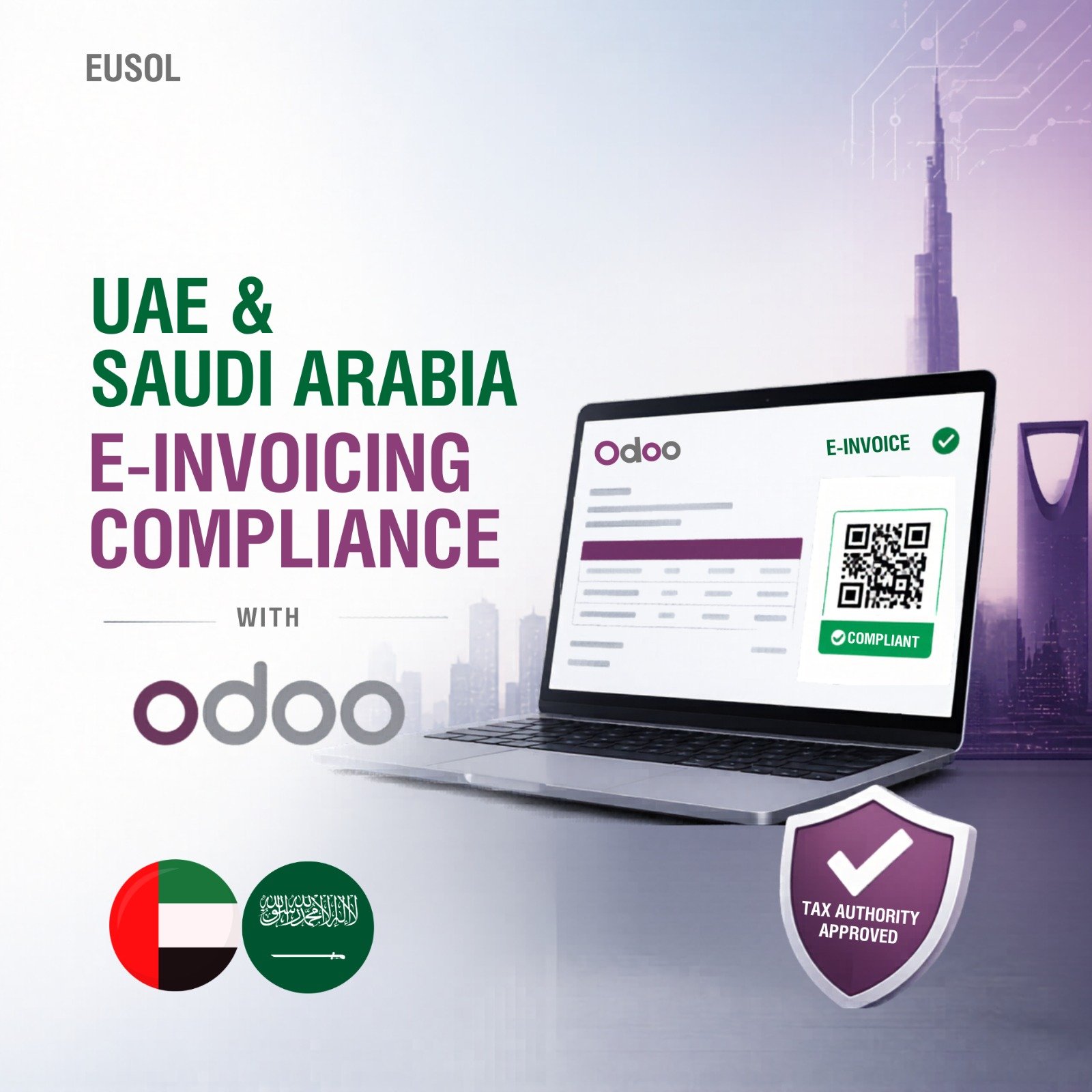
VAT and e-invoicing readiness. The UAE’s mandatory e-invoicing framework is rolling out progressively, with the pilot phase launching in July 2026. Odoo’s accounting module is built to support PINT AE-compliant electronic invoicing, ensuring your billing workflows stay ahead of regulatory deadlines.
Multi-site project visibility. Large UAE contractors regularly manage 10 to 50 active projects simultaneously across different emirates. Odoo’s centralized dashboard provides a real-time consolidated view of costs, progress, and resource utilization across all of them — eliminating the reporting delays that make early intervention impossible.
Subcontractor retention management. UAE construction contracts routinely involve 5–10% retention arrangements. Odoo tracks retention amounts automatically for each subcontractor, schedules release dates in line with contract terms, and prevents overpayments that can seriously damage cash flow.
WPS payroll compliance. Under UAE labor regulations, all salaries must be processed through the Wage Protection System. Odoo’s payroll module generates WPS-compatible salary files, reducing compliance risk and the administrative burden on HR teams managing large workforces.
Odoo Community vs Enterprise: Which Is Right for Construction?
Odoo offers two editions. The Community edition is free and open-source, making it attractive for smaller contractors wanting to test the system. However, for construction companies with more complex requirements, the Enterprise edition is strongly recommended.
Enterprise adds key capabilities including Odoo Studio for no-code customization, multi-company support for contractors operating across multiple legal entities, advanced reporting, and priority support. The Custom plan — which includes all of these — is priced at approximately $13.60 per user per month in the Middle East pricelist, making it one of the most cost-effective full-featured ERP options available to Gulf contractors.
How to Get Started with Odoo ERP for Construction
Implementing Odoo ERP for construction companies does not have to be a disruptive process. The modular structure means you can start with the areas of highest priority — typically project management, job costing, and procurement — and add further modules as your team becomes comfortable with the system.
A phased implementation approach works well for most construction firms:
Phase 1 — Set up project management, BOQ tracking, and job costing. Get real-time visibility into budget performance on active projects within the first few weeks.
Phase 2 — Implement procurement and inventory management. Connect purchase orders to projects and start tracking material costs automatically.
Phase 3 — Roll out HR, timesheets, and payroll. Eliminate manual wage calculations and generate WPS files from within the system.
Phase 4 — Activate CRM, subcontractor management, and full accounting integration. At this point, every part of your business operation is connected and visible in one platform.
Working with a certified Odoo partner who understands construction workflows and local regulatory requirements is strongly recommended. An experienced partner will configure the system to match your actual business processes rather than forcing you to adapt to a generic setup.
Ready to implement Odoo ERP for your construction business? EUSOL specializes in Odoo ERP implementation for construction and contracting companies across the UAE and Gulf region. From initial consultation to full go-live, our team configures Odoo to match your exact workflows — BOQ tracking, WPS payroll, subcontractor management, and VAT compliance included.
Conclusion
Odoo ERP for construction companies delivers exactly what the industry needs: a single, connected platform that gives every team member — from the site manager to the finance director — accurate, real-time information about every project. It eliminates the spreadsheet chaos, reduces procurement errors, automates payroll, and brings job costing out of the shadows and into the daily management of your business.
For construction companies in the UAE and across the Gulf region, where regulatory requirements are tightening and project complexity is increasing, the question is no longer whether to implement an ERP — it is which one gives you the best return on investment for your specific business. Odoo’s combination of modular flexibility, affordable pricing, and deep integration across every business function makes it the strongest choice for contractors of all sizes.
Take the Next Step with EUSOL
If you are a construction or contracting company in the UAE or Saudi Arabia looking to implement Odoo ERP, EUSOL is your trusted Gulf-based Odoo partner. We have hands-on experience configuring Odoo for construction businesses — from project management and job costing to WPS-compliant payroll and e-invoicing readiness.
What you get when you work with EUSOL:
- Free initial consultation to map your current workflows and identify gaps
- Odoo configuration tailored to construction — not a generic out-of-the-box setup
- BOQ setup, job costing structure, and subcontractor management from day one
- UAE VAT, corporate tax, and e-invoicing compliance built in
- Ongoing support as your business and your projects grow
Stop managing construction projects through spreadsheets and disconnected tools. Let EUSOL help you build an Odoo system that works the way your business works.