
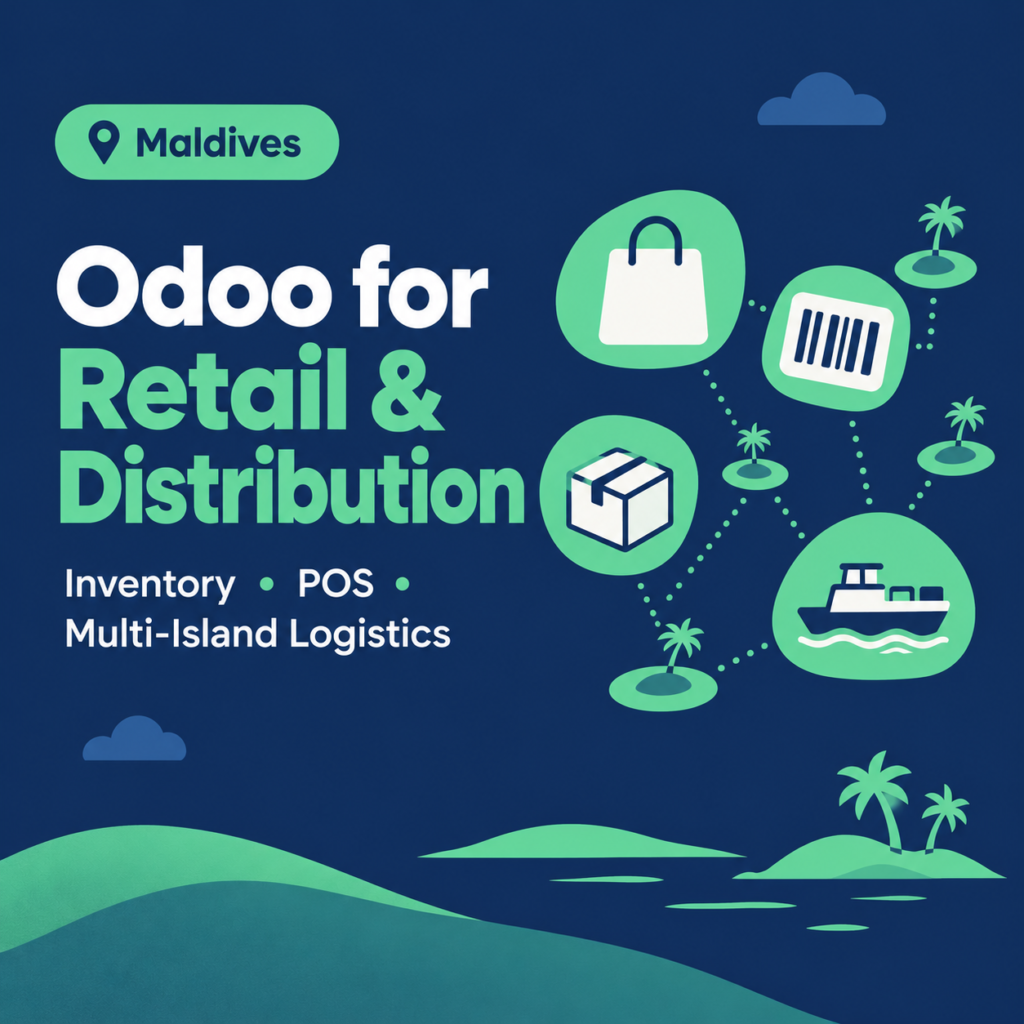


Running a retail or distribution business in the Maldives is unlike running one almost anywhere else. Your stock may arrive by sea freight, sit in a warehouse in Malé, and then travel by speedboat or dhow to shops, resorts and guesthouses scattered across dozens of atolls. A delayed shipment, a missed reorder or a pricing mistake costs more here than it would on the mainland.
Many Maldivian businesses still manage this complexity with spreadsheets, disconnected billing software and WhatsApp messages. It works until the business grows. Then stock counts stop matching, island deliveries get missed and month-end closing takes days.
This is where Odoo ERP changes the picture. In this guide, we explain how Odoo handles inventory management, point of sale and multi-island logistics for Maldivian retailers and distributors, and what to consider before you implement it.
Why Maldivian Retail and Distribution Needs a Dedicated ERP
The Maldives presents operational challenges that generic software rarely accounts for:
- Geographic fragmentation. Goods move between Malé, Hulhumalé, regional hubs and remote islands, often with irregular transport schedules.
- Import dependence. Most products are imported, so landed costs, customs duties, freight and currency fluctuations directly affect margins.
- Seasonality. Tourism cycles drive demand from resorts, guesthouses and local retail, so forecasting matters.
- Multiple sales channels. A single business may serve walk-in customers, resorts, wholesale buyers and online orders at once.
- Connectivity gaps. Internet on remote islands can be slow or unreliable, so systems must keep working offline.
An ERP built around a single, shared database solves most of these problems. Sales, purchasing, warehouse, accounting and POS all read from the same record, so everyone sees the same numbers.
What Makes Odoo a Strong Fit
Odoo is a modular, open-source ERP used by businesses of all sizes worldwide. For retail and distribution, its strength is that you start with the apps you need and add more as you grow. Core apps for this sector include:
- Inventory for stock, warehouses, transfers and barcode scanning
- Point of Sale for in-store and counter sales
- Sales and CRM for quotations, orders and customer relationships
- Purchase for supplier management and reordering
- Accounting for invoicing, multi-currency and reporting
- Website and eCommerce for online ordering and B2B portals
Because these apps share one database, a sale at the POS updates inventory instantly, which then triggers replenishment, which flows into accounting. There is no double entry and no reconciliation between systems.
Inventory Management: Stay in Control Across Locations
Inventory is usually the biggest source of cost and error in a Maldivian trading business. Odoo’s Inventory app addresses it in several ways.
Multi-Warehouse and Multi-Location Tracking
You can set up your main Malé warehouse, secondary storage on other islands and even vehicles or vessels as separate locations. Every internal transfer is recorded, so you always know what is where. Instead of calling the island branch to ask “how many units do you have?”, you check the dashboard.
Barcode Scanning and Faster Operations
Odoo’s barcode functionality lets staff receive goods, pick orders and run stock counts using a handheld scanner or smartphone. This reduces manual typing errors and speeds up receiving large shipments, which is especially valuable when containers arrive and the warehouse needs to move quickly.
Automated Reordering Rules
Set minimum and maximum stock levels for each product, and Odoo will suggest or automatically create purchase orders when stock drops below the threshold. For island businesses where resupply takes days or weeks, this prevents costly stock-outs.
Lot, Serial Number and Expiry Tracking
If you distribute food, beverages, cosmetics, pharmaceuticals or electronics, traceability is essential. Odoo tracks lot numbers, serial numbers and expiry dates, supporting first-expiry-first-out (FEFO) picking so older stock moves first and wastage stays low.
Landed Costs
Because most goods are imported, the true cost of a product includes freight, insurance, customs and handling. Odoo’s landed cost feature distributes these expenses across the received items, so your cost price and margins reflect reality rather than the supplier’s invoice alone.
Point of Sale: Fast, Flexible and Connected to Your Stock
Odoo’s Point of Sale (POS) is not a standalone till. It is part of the same ERP, which is its biggest advantage.
Key benefits for Maldivian retailers:
- Offline mode. The POS can keep processing sales when the internet drops and sync automatically once the connection returns, which is critical for remote islands.
- Real-time stock updates. Every sale reduces inventory immediately, across all branches.
- Multiple payment methods. Accept cash, cards and other payment types, with each method reconciled in accounting.
- Loyalty programs and discounts. Run promotions, gift cards and loyalty points to bring customers back.
- Works on any device. Run the POS on a tablet, laptop or touchscreen terminal, with receipt printers and barcode scanners supported.
- Multi-shop management. Manage several outlets from one backend, with consolidated reporting by shop, cashier or product category.
For a retailer with outlets in Malé and on other islands, this means head office sees daily sales, stock levels and cash positions across every location without waiting for end-of-month reports.
Multi-Island Logistics: Solving the Hardest Part
Distribution across an archipelago is where Odoo’s flexibility pays off most. While the Maldives has unique transport realities, Odoo’s logistics tools can be configured around them.
Routes and Delivery Planning
You can define multi-step routes, for example receive at the Malé warehouse, transfer to a regional hub, then deliver to the final island. Each step is tracked, so you know where every order is in the chain.
Transfers Between Locations
Internal transfers between warehouses are documented with quantities, dates and responsible staff. Whether goods leave on a scheduled cargo vessel or a private speedboat, the movement is recorded and visible.
Delivery Orders and Proof of Delivery
Generate delivery orders, packing lists and delivery notes directly from sales orders. Customers such as resorts and guesthouses receive clear documentation, and your team can track what was delivered and what is pending.
Handling Backorders and Partial Shipments
When transport is limited, you may not be able to ship everything at once. Odoo manages partial deliveries and backorders cleanly, so remaining items are scheduled for the next shipment without anyone having to remember them.
Carrier and Shipping Integration
Odoo supports shipping methods and carrier configuration, and it can be customized to fit local transport arrangements in the Maldives, where standard international carrier integrations may not apply.
Accounting, Currency and Compliance in One Place
Distribution and retail margins are thin, so financial accuracy matters. Odoo’s accounting integration offers:
- Multi-currency support for businesses that purchase in USD or other currencies and sell in MVR, with exchange differences handled automatically
- Automated invoicing from sales orders and deliveries
- Tax configuration for local requirements, including GST
- Real-time financial reports such as profit and loss, balance sheet, aged receivables and payables
- Bank reconciliation to match statements against transactions quickly
When inventory, sales and accounting share one database, your stock valuation flows straight into your financial statements. This removes one of the most time-consuming steps in month-end closing.
B2B Portals and Online Ordering
Resorts, guesthouses and wholesale buyers increasingly prefer to order online. With Odoo’s Website and eCommerce apps, you can offer a customer portal where approved buyers view price lists, place repeat orders and check invoice status. This cuts the volume of phone calls and messages your sales team handles and makes ordering faster for your customers.
Real-Time Reporting for Better Decisions
Because every transaction lives in one system, Odoo’s dashboards let owners and managers answer questions that used to take hours:
- Which products sell fastest, and which are sitting unsold?
- Which islands or customers generate the highest margin?
- How much stock do we hold, and what is it worth?
- Which suppliers deliver late?
Better visibility leads to smarter purchasing, less dead stock and healthier cash flow.
What to Consider Before Implementing Odoo
Odoo is powerful, but results depend on how it is set up. Before you start, think about:
- Process mapping. Document how stock, orders and deliveries currently move through your business, including island-specific quirks.
- Data quality. Clean your product list, customer records and opening stock before migration.
- Customization needs. Local invoicing formats, transport workflows and reports may need tailoring.
- Training. Your team needs hands-on training, especially warehouse staff and cashiers.
- Ongoing support. A system that runs your whole supply chain needs reliable local support after go-live.
This is why choosing an experienced implementation partner matters. A partner who understands both Odoo and the realities of doing business in the Maldives will configure the system around your operation instead of forcing your operation into a generic template.
Frequently Asked Questions
Can Odoo work for small retailers in the Maldives?
Yes. You can start with just POS and Inventory, then add Accounting, Sales and eCommerce as the business grows.
Does Odoo POS work without internet?
Yes. Odoo POS supports offline operation and syncs once the connection is restored, which suits islands with unstable connectivity.
Can Odoo handle imports and landed costs?
Yes. The landed cost feature allocates freight, duties and handling to products so you see true margins.
Can I manage multiple islands and warehouses in one system?
Yes. Odoo supports multiple warehouses, locations and multi-step routes, all visible from one dashboard.
How long does implementation take?
It depends on scope. A focused POS and inventory rollout can go live within weeks, while a full ERP deployment takes longer.
Conclusion
For retailers and distributors in the Maldives, the challenge is rarely demand. It is coordinating stock, sales and deliveries across a scattered geography without losing visibility or margin. Odoo’s connected approach, with inventory, POS, purchasing, logistics and accounting in one platform, gives Maldivian businesses the control they need to grow with confidence.
Ready to Streamline Your Retail or Distribution Business?
Eusol is an Odoo Gold Partner serving the Maldives. Our team designs, implements and supports Odoo systems built around the way Maldivian businesses actually operate, from Malé warehouses to island-wide delivery.
Book a free consultation today and we will:
- Review your current inventory, POS and logistics workflow
- Show you a live Odoo demo tailored to your business
- Give you a clear implementation roadmap and quote
Contact us now to get started.